
Transcript prepared by Qian Dan
Good evening, everyone, I'm Wu Yiqiang. It's been a while since I came out to talk with you all about photography, so I'm really grateful to Ant Photography, and thanks also to Mr. Ling Huge for inviting me to exchange ideas with you. The main thing is that I've written two articles, and I posted screenshots of them in the group, so you've probably all seen them. The background is that AI has arrived over the last couple of years, as you all know, and there has been a great deal of discussion about photography. The thing people talk about most is: what value does photography still have today? Or rather, many people have begun to doubt whether photography has a future, and they're quite worried. So you see, it isn't only the people around us; many photographers, too, are caught up in this anxiety to one degree or another.
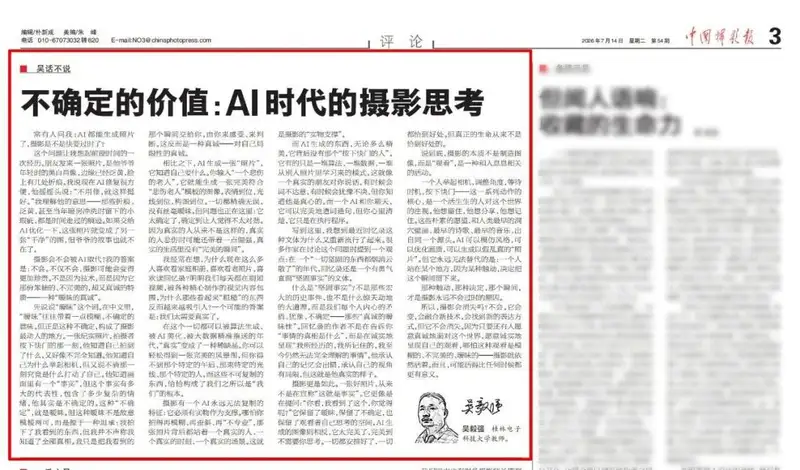
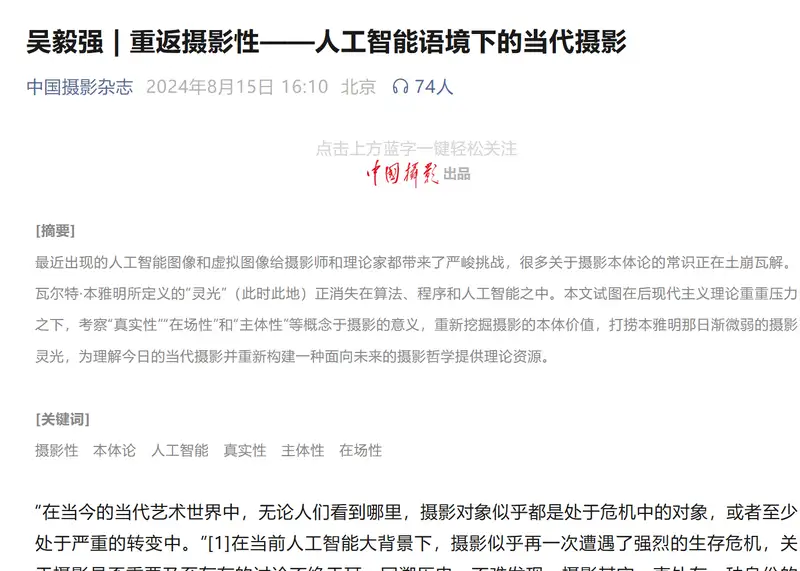
So in the face of this anxiety, I have some thoughts of my own, though I wouldn't call them especially profound. Artificial intelligence is, after all, something new, and frankly, when we talk about it now we can't possibly get to the bottom of it, because we all understand it only to a limited extent. But if you place it within the whole history of photography, you can still see some things that mark turning points and that are somewhat illuminating. So I wrote two articles in response to this anxiety. One was published in 2024 in China Photography magazine, titled "Returning to Photographicness: Contemporary Photography in the Context of Artificial Intelligence." The other was published a few months ago in China Photography News, titled "Uncertain Value: Reflections on Photography in the Age of AI." Really, both articles discuss one and the same thing, which is what I just said: what value does photography still have today? As photographers, what do we still need to hold on to, and what might we need to rethink? That is roughly the set of questions they respond to. Next, I'll talk through my thinking from roughly three angles.
The most direct occasion for writing these articles was that friends often send me a photograph. For example, a black-and-white photo of his grandfather when he was young, or of his grandmother or maternal grandmother. These photos have already yellowed, with damaged edges and creases. And I would say that AI restoration is very convenient and simple now, one click and it can be restored and turned into a beautiful photo. But sometimes, for reasons they can't quite explain themselves, they say, no need to restore it, it's fine just as it is. So what is the meaning behind that? My understanding is that those yellowed marks, those creases, or the small flaws left by darkroom processing back then, those imperfections, are all traces of history. They also bear witness to the time he lived through, to the fact that it really existed. If you optimize it, whether with AI or with Photoshop, if you restore it into a very clean, beautiful photograph, then of course it becomes perfect and spotless, but the traces of time are gone. Gone are all those experiences of your life that have come down across decades, including your impressions and reveries, and the stories of your grandparents, the stories that set you thinking.
This raises a question. Do we take photographs in order to get a spotlessly beautiful picture? Or does photography actually carry something strongly belonging to us photographers, the author as subject, something unique? What is it that you actually want? Do you want that polished, perfect so-called photograph, or something that carries your own history, the story of the person you photographed, and your emotional connection with them? This is what we need to think about. Speaking of this, I suddenly remember something else, about photography and what it is we want, for example, me.
What about all of us, when we post to WeChat Moments, or when we look at beautiful landscapes on Xiaohongshu, especially the travel photos on Xiaohongshu? They are basically all alike, and yes, they are truly beautiful; they give you an ideal, the kind of space you want, of that scenic spot. But why is it that when I look at some bloggers' Xiaohongshu, or other people's WeChat Moments, I actually feel that a real but imperfect photograph, with poor composition, colors that aren't vivid, even overexposed, flawed in all sorts of ways, but that photo carries strong information about its author at that very moment. For instance, he is in a very dim space and has taken a picture of a terrible environment, and I immediately think of his situation at the time. That kind of thing moves me more. If someone takes an especially beautiful photo of, say, Guilin, where I am right now, I feel not the slightest thing, because there is just so much of it. I only need to open Xiaohongshu at random and search "Guilin landscape," and what everyone has in mind is just those same few things, right, very urbanized symbols. But a photo that carries the author's information, his sorrow or pain or whatever he feels, that kind of thing I actually want to look at a little longer.
It's the same on Moments. When I see something very glossy there... I have a lot of photographers in my Moments, you're all photographers. I've noticed that photographers all have one trait: they always post an especially perfect set, nine photos or however many, and you can tell at a glance it's a carefully edited set about where they went. For promoting that place, that's of course very good. But for me wanting to learn about you as an author, to get a sense of you, I feel those photos don't have much to do with you. Do you see what I mean? I would much rather see you share the little details of your life. For example, something happened to you today, you had a thought, and you attach a very imperfect picture. Say you're in a hospital, in that dirty, messy environment, and you just snap something, with no need to be particular about it. With something like that, I start thinking about you as a person from the picture, and I can feel your situation, your thoughts, your ideas, your feelings. For example, I often have relatives and friends in the hospital, and a photo you took of some corner of a hospital could very well move me, because I've been in that same situation myself, I know the atmosphere of those hospitals very well, and that kind of thing is actually very moving.
So if you use AI, or some other means, to generate an especially perfect landscape or picture of some place, of course we still need that kind of thing, certainly. Especially in publicity, in promoting a place, in conveying a lovely experience, I think it is still needed. But our lives are not only about conveying lovely experiences. There is sadness, hesitation, even ambiguity, and I'll come back to that word in a moment. These are often the main theme of our lives, and so they can actually move people even more.
So if someone asks whether AI will replace photography, my answer is of course not. Not only will it not, I feel that photography is, if anything, more precious than before in this era, precisely because AI has come crashing in like this. Before AI, I did sometimes feel that taking photographs had become too easy. You shoot, I shoot, a phone makes it so convenient, and very often people take pictures without thinking, without using their heads, just click. There were simply too many, and looking at them was tiring and fatiguing. But after AI arrived, you discover that the fatigue AI brings you is far greater than that from photographs we humans take. At least that's how I feel. AI gives you a feeling of emptiness, and you don't know where the thing comes from, where its roots are. It has no roots; it's like a ghost floating there, an image pieced together out of algorithms and a jumble of information piled up or kneaded together. Frankly, that shouldn't even be called photography. So when facing such images, you can't find any connection between yourself and them. Why does it make you feel empty? Because you can't find any intersection between your own life and it, so it feels very foreign. It can't produce empathy in you. You'll notice that many AI-made faces, for example, can still be recognized at a glance, right? They're still not quite the same as what we actually shoot.
So photography today, in the age of AI, actually seems more precious than before. This is something AI has brought; some might call it an impact or whatever, but I feel photography has been, as it were, through a great winnowing and a tempering, and has become sturdier and more indispensable. Not because it is perfect. Photography is certainly imperfect, especially the photos we take ourselves, which have plenty of flaws. But it is precisely that clumsy, imperfect, and yet especially sincere feeling that I wrote about in the article, a kind of ambiguous sincerity.
I think the word "ambiguity" suits photography especially well. What is ambiguity? It means not quite certain, a bit blurry. It's like when we take a photograph, or look at a photo by some photographer (I won't show an image here), you can just think of any one, for example Xie Hailong's "Big Eyes," the girl with those eyes of hers, right. Just that one photograph, and the feeling it gives me, why is it so classic? I think its greatest charm lies precisely in this ambiguity. So what exactly does this ambiguity mean?
Why can a photograph like that become a classic? I think it is precisely the word "ambiguity." This isn't the bad kind of ambiguity we usually speak of. So what does it mean? It's that, when Xie Hailong pressed the shutter to take this photo, do you think he really had it all figured out? You see, today we're always talking about conceptual photography or whatever other kind, as if you had to have a very clear idea first, right? In fact that's hardly possible. When Xie Hailong took this photograph, did he really have it all figured out? What kind of person he wanted to photograph, he really hadn't thought it through. He just felt that in that moment the girl's eyes, that longing, moved him. He knew he had photographed this subject, those eyes, but whether he knew exactly why he was moved, he actually didn't quite know either.
All he knew was: I photographed a girl, she has big eyes, and there are many complicated emotions in those eyes. We can't even say whether that look is longing or what. Nor should we interpret it too categorically, saying those eyes are full of a thirst for learning. I think you can't really get that reading out of it. Suppose you go to a mountain village in the west, photograph a girl's eyes, and she looks at you; can you tell what she is thinking? Right? The emotions in her eyes are in fact very complex. You're uncertain. When you meet her, when your gazes meet, four eyes looking at each other, both sides are actually uncertain. You don't know what she is thinking, and she may well be looking at you with suspicion. That is ambiguity: uncertainty, equivocation.
All you can say is that, as a photographer, he was sincere. That's why a photographer's sincerity matters so much. Where does his sincerity lie? It lies in this: I photographed what I saw, I did not lie. As for how you all see what I photographed, I don't know. For example, this photograph was later used for Project Hope. That wasn't a clear idea he had before shooting. It was only later that the education bureau, or the relevant parties, felt the photo could be used to promote Project Hope, by adding text to interpret it. Because, as we all know, the meaning of a photograph is very often uncertain; its meaning floats. If you want its meaning to settle, words have to come in. This is why so many news photographs must come with text, saying when and what happened. Otherwise the photo's meaning slips away; it loses its anchor. You should all understand this. It's also a very important point in how we read images today: there must be context. If a photograph has no context at all for you to read it by, it is really hard to read, because its meaning drifts.
But one thing is certain: when Xie Hailong took this photograph, he was very sure in his heart that he wanted to capture what he saw. He didn't claim to know the whole truth, but he handed you, just as it was, the moment he had captured. What you make of it is up to you; feel it and judge it for yourself. I think that is a kind of sincerity. This sincerity isn't the photographer posturing, as if he understood everything. A photographer is not God; he stays open about what he has photographed and cannot monopolize the meaning of the picture. I can't say that what this photo means is for me to decide; it should be for you to look at and feel, and you decide. I think that too is sincerity, sincerity about one's own limitations. Because I know I'm not omnipotent, and at that moment I'm simply being honestly faithful to my own feeling and photographing it, which doesn't mean I understand everything. Do you all feel this too? I think that is very sincere.
Now, by contrast, look at AI-generated photos. Say you ask AI to generate a child longing to study, or a sorrowful old person; it can give you a photo that fits your idea perfectly. The stereotype of a child longing to read or a sorrowful old person, it will certainly do very well. The expression is right, the lighting is right, the composition is right, everything is precise and perfect, and there is none of that blurry ambiguity. Its theme is very clear, because the prompt you entered asks for exactly this, and it goes and pieces together all sorts of things that meet the requirement to generate a very definite picture. So it gives you a perfect photograph, but think about that perfect photograph. You can try it right now with Doubao. For instance, enter "a child longing to learn"; can you imagine the photo? Everything is perfect, but it just isn't real.
You'll find it rather fake, cold, not a real person. So you won't think about what story might lie behind this person. That is the charm of photography. This is why, as you can see, the people around me, and I myself, and many others, like to read family albums, old photographs, memoirs, or biographies and documentaries; I love these especially. Why? Because in a world packaged so beautifully, where every day we scroll through all sorts of stuff and can't tell what's true, these give you something relatively real. Of course you can't say it's entirely real; it's just relatively sincere, and with its own limitations it offers you something relatively sincere to look at.
Take memoirs, for example. A person's memoir surely has plenty of misremembering, right? Think about recalling your own life, from childhood all the way to now. What you tell is of course your real feeling, but there are surely quite a few things you've misremembered. Yet why do such memoirs still move people so much? Because it is the real thing you wanted to tell, you are expressing it sincerely, you really did think that way. Your expression is real, which isn't to say that what you describe is absolutely real. These are two kinds of reality. You are faithfully telling your feelings, and that's fine. Whether the feeling you describe is objectively true is another matter. But that alone is actually enough: your sincerity in wanting to express an object honestly has already moved me. Documentaries are the same. Why does someone making documentaries, or our documentary photography today, move people so much now? Think about it: a person with a camera
goes to all kinds of out-of-the-way corners to shoot material or subjects we rarely get to see, and that is because it's scarce. If you don't go to that place, you can't photograph it. What you generate with AI is simply fake, right? If you didn't go, you didn't go. So today, in this era, which we could also call a post-truth era, the real is far too scarce. The real is a scarce commodity. You can easily get a perfect image, landscape or portrait, with cinematic exposure, flawless exposure, harmonious colors, everything the way you'd ideally want it. But all these ideal things have nothing to do with that particular person, that particular time, with someone being in one place at one moment in one space, these unrepeatable things. And it is precisely these things that constitute what makes us human. That is, as living people, at what time we were there, what space we entered, what we left behind, these are our basic attributes as humans, the support of being human. Without this, how could we prove we are alive? I think that is a question AI, however powerful, cannot answer today. You can create something out of nothing, but what is created from nothing floats; it has no roots and can't land on the ground.
I've spent about half an hour talking about the unique, irreplaceable scarce value of photography in this age of AI, which I think is quite important. For the next half hour, I'd like to follow this topic and make it a bit more theoretical. What I said before was quite colloquial; next I'll do a basic run through the theory, which you could also call a kind of theoretical construction. That is, we place this feeling within the whole context of photographic history or photographic theory, to give it firmer support.
The first thing I want to discuss is the ontology of photography. This is a huge topic, and I don't want to discuss it in an overly academic way; that wouldn't be quite appropriate. But I do want to say something, and talk about it in a fairly colloquial way so that everyone can follow. We just spoke about the roots of photography, or a term I use in my article, "photographicness": what is the unique photographicness of photography? Since its birth, photography has in fact endured many shocks. For example, at the very beginning there was the dispute over its standing relative to painting, when people like Baudelaire always looked down on photography, considering it the work of a robot, lacking subjectivity and the artist's quality of authorship, so they had no regard for it. Later, digital photography appeared, and with retouching in Photoshop and so on you could construct images, and by the time AI arrived you could even generate them. All of these posed serious challenges to photography's ontological nature. So today, when we look back and ask what is the unique photographicness of photography, the question becomes very important, and one might say a difficult one. But we should know that what is called objective truthfulness is one of photography's most salient natures; it should be this objective truthfulness.
Put simply, it is our desire for and faith in the real. This has a long history. Photography gave us an imagination of, or faith in, the real. We can only use the words imagination and faith here; we can't say that what photography gives us is the real itself. I think there is a consensus on this now, especially after postmodern theory. Photography was born in a modernist environment, but today's is a postmodern society, and modern theories have taken many blows from postmodern ones. So when it comes to what is real, what is objective, and whether photography can give us this real objectivity, we must put these words in quotation marks.
But there is one thing that can't be questioned: it gives us a faith in the real. As I said just now, when we shoot, it isn't that I hold the truth; it's that I want to tell you what I believe to be real at this moment. Do you appreciate the weight of that sentence? The reason I photograph, and as a photographer my greatest value, lies in the fact that I don't claim to hold absolute justice or truth in my hands. Rather, I want to present to you, truthfully, what I see and think and gather at this moment. This is my faith, and also the faith photography gives us: it offers us an imagination of the real. We imagine that there ought to be something like this out there, something knowable. I think everyone can understand this.
Early French theorists, such as André Bazin, whom you all know, and also Roland Barthes, held this view. They held that photography, or the image itself, gives us a real and complete object that painting or other art forms cannot replace. It has objectivity because it has some real connection with the subject photographed, especially in the film photography of the past. We say that the image formed on the plate is produced by light from the objective subject falling on it; that relationship exists. We can also call this indexicality, the index. What we photograph has, in real terms, a kind of physical link to the subject you photographed. This isn't imagination: light strikes the object, travels to you, and the light emitted by the object is captured by your camera to form an image, right? There is a physical connection, and an AI image clearly lacks this; a generated image doesn't have it.
So you can't reject this. Although it provides that physical connection, we also can't say how much truth it gives; that's hard to say. But the physical connection is undeniable. So this is the most far-reaching idea, I think, since photography's birth up to today: the most essential connection between photography and its subject, a connection in reality, or in an optical or physical sense, which you can't get away from. Without this, I think it wouldn't be called photography, right? Photography must have this connection. In his famous book Camera Lucida, Roland Barthes says "that-has-been," right? That-has-been, meaning this thing once existed. That is his summation of the ontology of photography. It's as when I see a photograph of my grandmother, and Roland Barthes was the same, seeing a photograph of his mother or grandmother; that person truly existed. When we look at old photographs today, of your grandparents or parents, even those who have passed away, you believe they once existed, right? That is completely different from looking at a photo AI created out of nothing.
So these theorists, Roland Barthes, André Bazin, held that a photograph and its subject have an extremely strong link. In a sense, a photograph provides a kind of purple of reality, of the real, purple, purple.
It points to the real. I'm not saying it represents the entire objective truth, but it points to the real, and nobody denies that, right? You can't deny it. So why does photographic realism, and with it our documentary photography today, have such a large following? It comes from our faith in it. People have always held that this is what photography is, especially many traditional, technique-minded photographers, who will say, oh, what you do isn't photography, what I do is photography, right? Because he feels he is facing a real world, that I photograph what my own eyes see. And the images you manufacture are not photography. Especially many contemporary artists, who use computers or today's AI, they go looking for images themselves.
So the two are really different, although both use images to express themselves, their ways of working are completely different. And this realism in photography, I think it's called realism, basically the practice of recording some truth of the subject, we call it the realist practice of photography. Why does it keep staying vibrant even today, with more and more people continuing to record the world in this way? That is in fact a faith, a faith in the truthfulness of photography, and where does this faith come from?
It comes from a very long-standing metaphysical tradition, and we could say this metaphysical tradition is our longing for the vanished God. A longing for that solid thing that never decays or disappears, because photography can preserve for us what easily vanishes. Isn't this a faith? Just as we
Just as Westerners used to believe in God. After God died, we substituted photography. Before, we used painting, but we found that painting, in preserving truthfulness, is far inferior to photography, so photography became a new faith, especially a faith in truthfulness. So philosophically this is a tradition, a longing for the immortal and the eternal, a metaphysical tradition. It has continued to this day, so it will never disappear. Holding on to this, I can't say photography will disappear or be replaced; it never will be.
Using AI to generate a photographic image and taking a photograph with a camera are two completely different experiences, so how could one replace the other? Right? How could it? Good, just now I
Good, just now I was saying that today we can't be so sure that photography gives us absolute truth, or objective truth. That is because, after reading so much postmodern theory, we really do come to doubt whether the truth we used to understand is as beyond question as we thought. That is, whether what we photograph, whether that photograph, can stand in for objective truth, or objective reality. Right, in fact it really can't. We are photographers, and we are indeed committed to recording, to faithfully recording our feelings and what we see, but whether what you record represents objective truth,
we can't be so certain of that either. This is the doubt postmodern theory gives us, and I think its nourishing side is right here. That is, when we say photography, and film too, what is shot cannot be said to correspond entirely to reality, or to equal reality, let alone to copy reality. Take Baudrillard: he says such images, as simulacra, precede the real; he even holds that reality imitates the image, the image comes first and then reality, and we are imitating that image. And as Derrida said, there is nothing outside the text. They rank reality below the image or the text: it isn't that we imitate reality, but that reality imitates the image.
So this turns things upside down at the root, overturning our earlier understanding. Put simply, these theorists hold that the meaning of photography does not come from the thing photographed, but from the combined result of everything that follows, including the camera: the operations, production, dissemination and reception. That is, the meaning of a photographic image is constructed. It isn't that we photographers start with some motive to shoot something, and then the thing is fixed and certain. That is not how it is. Especially looking at it today, it really isn't. So I think postmodern theory has a lot of nonsense in it, which truly deserves reflection today, but I think its questioning of truth is fine. It questions whether photography can offer a truth, and I think that questioning is fine, right? It doesn't contradict what we said earlier.
So today, AI images, along with postmodern theory, hit the values of traditional photography very hard, and that is why we are anxious today. The so-called real, objective, absolute values we used to believe in were the cornerstones of our faith, and now they've all begun to collapse. So the next question we have to ask is: on this ruin today, where are we humans to go?
In this so-called post-truth era, when we seem unable to find the truth, how do we rebuild humanity's pursuit of faith in truth and value? Because I believe people always need something to believe in; otherwise your life feels meaningless, right? Having no definite goal to look for, no search of your own, how painful that would be. So in my second point I raised two terms, presence and subjectivity. Or we can put it as two questions. The first: is the relationship between the photographic image and its subject really extremely weak?
That is, is the relationship between the image and the subject really extremely weak? As we said before, a mere thread, so weak that we can completely ignore its reference to the real. That's the first question. The second question is: the meaning of the photographic image is endlessly encoded or translated in dissemination, so where do we photographers, as producers of photographs, find our value or meaning? Because the meaning of a photographic image is constantly encoded and translated, constantly diluted and reinterpreted. So you, the photographer who first took the picture, where is your meaning? The photograph you sent out may eventually be completely different from your original intention. So where is your value?
Digital photography is an abstraction of our reality today. But in digital photography, humans are still present, right? You are the one modifying what you photographed. Retouching in Photoshop is like this: you are present, you are modifying. Artificial intelligence, however, drives the human out of the scene altogether, making AI images drifting, now-you-see-it-now-you-don't ghosts. Right, so where is the photographer's subjectivity? Do we still need to stress the photographer's value and meaning? Right, I have actually already partly answered these two questions.
For example, the first question: is the relationship between the photographic image and the subject so weak that we can completely ignore its reference to the real? I think it can't be ignored. That is my answer to the first question. Of course we can't wishfully equate photography with reality, thinking photography means truth; that would certainly be naive. But we also can't separate photography completely from truthfulness, totally deny its objective side, and we can't deny its physical link of reference to the real. That is, the inborn connection between photography and reality: once you press the shutter, light enters your viewfinder and falls on our photosensitive element, whether film or CMOS, as long as that relationship is formed, then the inborn tie between them, however slight, is not nothing, and is far from nothing.
AI images, that's the first question, and that's how I answer it. The second question is: after a photographic image is produced, it is indeed endlessly encoded, transferred and reinterpreted, entering what you might call a deep ocean of meaning. Everyone can inject new meaning into a photo and reinterpret it, so the meaning of a photographic image changes with context. Or we photographers truly find it hard to control the final meaning of a photograph, right. That is, if you take a photo today and don't control it or add any explanation, what kind of photo it ends up becoming to some extent, what occasions it gets used in for publicity, or what meaning it expresses, we cannot control at all; you really can't control it.
But even so, can you then deny the photographer's effort in producing the photograph? I think you can't. Everything the photographer does while shooting, such as carrying out his intentions, controlling the shooting environment and equipment, handling light and composition, all of this is a real contribution to producing meaning. We can only say that the photographer may produce half of the meaning, and the other half is handed to the world, to other media organizations or ordinary viewers, half and half. You can't ignore the other half because of this half, and you can't deny the value of the other half because of this half.
So as the first party responsible for injecting meaning into a photograph, I still think it is the photographer. He is the one who injects meaning into photography first, not anyone else. Right, it's as if you are the mother who gave birth to a child; what the child later becomes may be hard for you to control, but you can't deny that you are this child's mother. This is the photographer's presence and subjectivity. I think that whatever the era, however AI develops, these two points can't be replaced. This is also fairly easy to understand: I think the photographer is still the first party responsible for producing the meaning of the photographic image.
It's like a child's mother: even if after giving birth you may not raise the child, and hand it entirely to someone else, so you have no say in how the child turns out and don't even know, the child is still yours. He carries a lot of your genes from birth; your genetic information is all in him, right. Having answered these two questions, I'm reminded of Benjamin, whom you all know very well, the author of "The Work of Art in the Age of Mechanical Reproduction." In fact, in an essay earlier than that one, called "Little History of Photography," he wrote some
foreshadowing, I think, and it actually touches on the photographicness we're discussing today. For example, in analyzing portrait photographs he says, the viewer feels an irresistible urge to look in the image for the tiny spark, the accidental spark, of the here and now.
Another line is that only through photography do we become aware of unconscious phenomena. The unconscious. That is, on one hand Benjamin was especially amazed by the realist power of photography. He thought: how can photography reproduce the appearance of an object so precisely? That is really remarkable. At the same time, he also cared a great deal about the shock and tremor that the tiny spark in a photograph brings. The shock and impact that this tiny spark gives people. This is a special encounter between photographer and viewer inside the photograph. What the photographer photographed and the viewer looking at it produce a spark, and he said this is a special encounter between photographer and viewer in the photograph, a wonderful experience. It is also a strong expression of the photographer's presence and subjectivity. And this mysterious, unique, splendid experience is something AI images can hardly offer us.
So that unique aura around a photograph, that here and now, only photography can truly possess. That is why he later spoke in the essay of the decay of the aura, right. But this aura is exactly what is unique to photography. Mechanical reproduction made its aura decay, which was actually a bad thing. In this age of AI today, that aura of the here and now makes us feel that photographicness is worth pursuing again. That is what I mean: photographicness is truly important and truly scarce.
OK, time's nearly up, so let me sum up at the end. In today's surging age of artificial intelligence, all of photography is undergoing unprecedented shocks and questioning. But as I told you just now, I think photography is far from, or rather it is a very complex act: photography is not the photograph, photography is an act, right? You know photography is an act. It involves three things: the subject, the camera, and the photographer. Photography is the result of these three things, the photographer, the subject and the photographic apparatus, that is, the camera, combining and responding in coordination.
Photography is an act in which the three respond in coordination. And the photograph is this, this is a triangular relationship. What does this mean? It means photography has a natural relationship with reality: the photographer must have a subject, and that is a natural relationship. It can't be fictional, right; you are photographing something, so there is an optical, physical relationship, and it can't be fictional. At the same time, photography requires the photographer's own bodily presence. If you're not there, how can you shoot? If you're not there, how do you control the camera? How does the photographer's subjectivity show itself? So the photographer's bodily presence is what we call presence.
That is why I see so many photographers today still traveling all over the world, going to capture special scenes. They are present; they must remain present. So I think this unique photographicness, or the aura we spoke of earlier, is this: I am here, now. That is Benjamin's aura, and also what I call photographicness. It is very, very important. It can withstand any impact from what we call virtual photography today. These two things can't be replaced, right? AI images have an unknown origin and a dubious destination, very much like a ghost drifting through this era.
If you lack a strong cultural system to integrate and read such images, they are meaningless. They must be integrated and used by a cultural system to produce meaning. So, in a final sentence: the more AI images flood in, and the easier photography becomes, the more precious it appears. OK, that's it for my talk today. Thank you all, and let's talk again next time when we have time.